
Checking for a Warrant in Brookline
Brookline is compact enough that the police station and the courthouse share a street, yet they answer different questions. Follow the steps in order. Done right, you will not repeat any of them.
- Find the case or citation number on the paperwork, or ask the town where the case began.
- Search Massachusetts Trial Court Case Access under the Brookline District Court division.
- Enter the exact case number, because most criminal matters will not return on a name search.
- Call the Brookline District Court clerk and ask whether the case is in default and what a recall requires.
- Request any police report from the Brookline Records Division, and keep written proof of what the court tells you.
Note: A missing result in the portal can mean the wrong division, a sealed file, or a recent Brookline entry that has not posted yet.
Brookline Police Records and the Daily Log
The Brookline Police Records Division takes requests by mail and online, and anyone can read the public daily log at the front desk at any hour. Searching the log goes faster with the right date, location, or time, so bring what you know instead of guessing. A CAD or incident request follows the same route. The Records Division page lays out that request path, and the daily log is a general account of department activity rather than a case index.
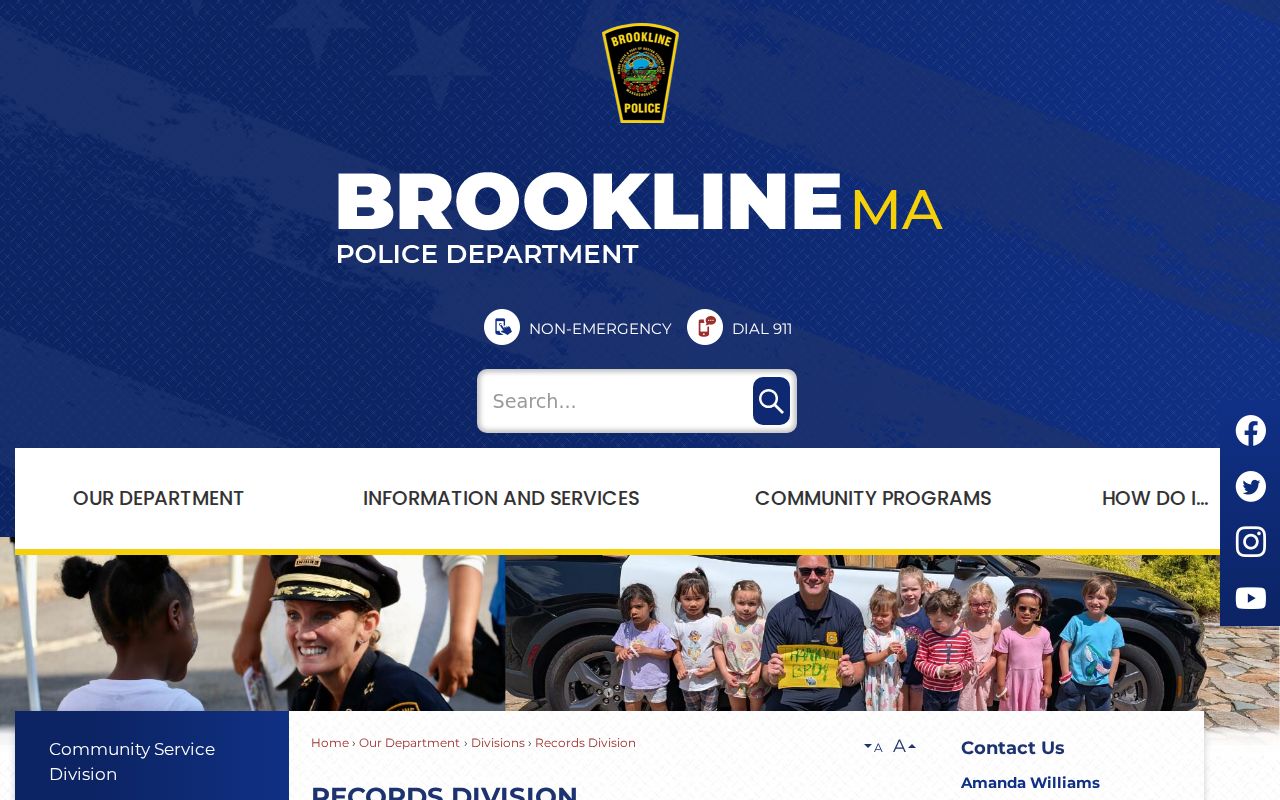
Ask the desk what the log covers before you request a date range.
Brookline Police Records Division
350 Washington Street
Brookline, MA 02445
(617) 730-2225
Brookline District Court, Clerk's Office
360 Washington Street
Brookline, MA 02445
(617) 232-4660
For the request process itself, the records clerk named on the Brookline division page is the person to ask.
Brookline Police and Municipal Court
Massachusetts has no Brookline municipal court. Town bylaw citations can start with the town and run through a noncriminal process, but any criminal warrant question belongs to the District Court serving Brookline, and the town has its own division rather than sharing one. The split is easy to remember. Brookline Police make arrests, hold reports, and may serve process named in the state system. The court records the default, sets bail, and decides whether to recall a warrant.
Brookline's Own District Court Division
Brookline District Court serves the town alone. That is unusual in Norfolk County, where several divisions cover groups of municipalities. A Brookline case therefore stays put rather than migrating to Quincy or Dedham. When a clerk cannot find a file, the identifier is usually wrong, not the courthouse.
Court business runs on weekday hours. A Brookline plan that starts late in the afternoon rarely finishes the same day.
Brookline Warrant Types
A Brookline case can produce any process type Massachusetts uses. The name on the paper points to the office holding the file.
| Warrant Type | How It Arises | Who Issues It |
|---|---|---|
| Arrest warrant | A criminal complaint or indictment in a Brookline case | District Court, or Superior Court after indictment |
| Default warrant | A missed arraignment, hearing, or trial date | The court that recorded the default |
| Payment-only default | An unpaid fine, cost, or restitution order | The court that ordered the money |
| Search warrant | Sworn facts about a place, vehicle, or records | A judge, on probable cause |
Massachusetts materials use default warrant as the formal term. In everyday speech, Brookline callers say bench warrant for the same order.
Parking Tickets and Court Warrants in Brookline
Brookline's Traffic Division handles parking-ticket administration, appeals included, along with payment questions. That work sits apart from the court process, and confusing the two offices wastes time. A parking dispute is a town matter. A criminal complaint, or a default after a missed court date, is a court matter. If a citation did become a criminal case, the question moves to Brookline District Court, and the town can no longer answer it. Ask the court clerk to say where the matter stands: still a civil infraction, an open criminal case, or already in default. The clerk's answer tells you which counter to work with and whether a warrant could be part of the picture at all.
Inside a Brookline Warrant Record
The docket number tells you which courthouse holds the file before anything else. Brookline District Court's division code is 09. A number carrying that code belongs to that court.
| Docket Number | The exact court identifier, capital letters and leading zeros included. |
|---|---|
| Charge or Offense | The offense named in the complaint, with its felony or misdemeanor designation. |
| Issuing Court | The court that authorized the process and controls recall, bail, and the next date. |
| Responsible Department | The police department named to serve the warrant in the state system. |
| Status | Whether the warrant is open, served, or recalled as of the court's last update. |
Brookline Letters of Good Conduct and Warrant Checks
Brookline Police issue a local letter of good conduct for residents who need one, and the division's page lists the requirements: current Brookline residency, a state identification card, and a recent state criminal record check. Those items are about residency and identity, not about warrants. A letter of good conduct is not a warrant certificate. It does not confirm that nothing is pending, and it clears nothing. Treat it as a local character reference. Confirm warrant status with the court that would hold the file. Note: The state criminal record check behind a local letter is a separate product from the court file and the state warrant system.
How Brookline Warrants Fit the County System
Brookline cases follow the same structure as the rest of Norfolk County, even though the town has its own courthouse. The court issues process. The police department named in the record serves it, and the sheriff runs the jail.
Warrant flow: Brookline District Court or Superior Court › responsible police department › Warrant Management System
Criminal process may be served anywhere in Massachusetts. A Brookline warrant can be executed well outside the town. For county and state steps, start with Norfolk County warrant records.
How a Brookline Default Warrant Affects Licenses
A Brookline default warrant that gets recalled in court is not always cleared everywhere. The state warrant system still shows it as open until the recall posts there. That stale entry can bite in ways people do not expect. Under M.G.L. c. 276, § 23B, a match in the warrant system can suspend a professional license, permit, or business authorization once the holder gets notice and a chance to be heard. So a Brookline recall is not finished when the judge signs it. Ask the clerk when the entry will post in the system. Ask for the recall notice in writing too. That paperwork settles any dispute later.
Brookline Warrant Records and Public Access
Brookline warrant records sit under two different access laws. Town office records follow the Public Records Law. Court records follow the Uniform Rules on Public Access to Court Records instead. A docket you cannot view remotely can still be read at the courthouse.
Key Rules:
M.G.L. c. 66, § 10 - the public right to request records held by a town or state office.
M.G.L. c. 4, § 7(26) - the exemptions an office may apply when it withholds or redacts material.
M.G.L. c. 276, § 2B - a search warrant affidavit stays nonpublic until the warrant is returned.
Brookline's public records request page explains how to submit and lists the town's fees.
Brookline Warrant Recall Walk-In
Lifting a default takes a judge, not a phone call alone. Start with the clerk's office in Brookline and plan to appear in court. Staff pull the case file first. Probation may add information, and then the judge decides whether to recall the warrant and on what conditions.
Caution: Arrive early in the day if the court asks you to appear, and do not leave without written proof that the default was removed.
Bring photo ID and the docket number. Bring proof that explains the missed date, plus a way to pay any court fee. For the full recall process, the bench warrant guidance covers fees, hardship waivers, and payment-only defaults.