
Checking for a Warrant in Norfolk County
Start with the court named on your paperwork. Not the jail. In Norfolk County, each of the five District Court divisions serves its own municipalities, so a Quincy citation stays in Quincy and a Franklin case lands in Wrentham. Criminal dockets generally require an exact case number, so bring the paperwork and a date of birth when you contact the clerk.
- Identify the issuing court from the municipality where the case began, or check Superior Court for an indicted case.
- Search Massachusetts Trial Court Case Access by court department, division, and location, then use the Case Number tab.
- Use the Ticket/Citation Number tab when a citation started the case, copying the number exactly as printed.
- Call the Clerk-Magistrate's office to ask whether the case is in default and what the Norfolk County court requires to recall a warrant.
- Ask the police department named in the case for reports through a records access officer.
Note: A clean MassCourts result does not prove no Norfolk County warrant exists, because the portal is a case index.
Norfolk County District Court Divisions
Norfolk County runs five District Court divisions. The division follows the municipality where the case was filed. Picking the wrong one returns nothing, which can look like a clearance when it is only a mismatch of courts.
| District Court | Municipalities Served | Case Code |
|---|---|---|
| Brookline | Brookline | 09 |
| Dedham | Dedham, Dover, Medfield, Needham, Norwood, Wellesley, Westwood | 54 |
| Quincy | Braintree, Cohasset, Holbrook, Milton, Quincy, Randolph, Weymouth | 56 |
| Stoughton | Avon, Canton, Sharon, Stoughton | 55 |
| Wrentham | Foxborough, Franklin, Medway, Millis, Norfolk, Plainville, Walpole, Wrentham | 57 |
The case code inside a District Court docket number confirms which Norfolk County court issued the process. Norfolk County Superior Court sits apart at 650 High Street in Dedham. Juvenile matters follow a map of their own.
Norfolk County Warrant Types
Massachusetts uses several names for court process. The differences matter when you need to know who holds a record. The statutory term for a warrant after a missed appearance or a broken release condition is a default warrant. Norfolk County clerks may say bench warrant too, since that phrase is common shorthand.
| Warrant Type | How It Arises | Who Issues It |
|---|---|---|
| Arrest warrant | Criminal complaint or indictment when a person may not appear unless arrested | District Court, or Superior Court after indictment |
| Default warrant | Missed arraignment, hearing, or trial date, or a broken release condition | The court that recorded the default |
| Payment-only default | Unpaid fine, court cost, restitution, or support order | The court that ordered the money |
| Search warrant | Sworn facts about a place, vehicle, or records | A judge, on probable cause |
A search warrant is not an arrest warrant. Its affidavit stays sealed until the warrant is returned, so a Norfolk County search-warrant question often ends at the clerk's desk.
Why the Sheriff Is Not a Norfolk County Warrant Search
The Norfolk County Sheriff's Office says plainly what it is: a jail and house of correction, not a police department and not a court. Police records must be requested from the city or town department that created them, and charge questions belong to the court. The Sheriff's public records page does name the requests the office handles, such as custody and bail records.
One sheriff function touches warrants, civil cases only. The Civil Process Division in Quincy serves a civil capias on a judgment debtor after a voluntary court date and three chances to appear. That is debt collection, not the Norfolk County criminal warrant lookup.
Inside a Norfolk County Warrant Record
A court docket lists the case number, charges, events, and dispositions. The system police share with the Registry of Motor Vehicles holds more. It adds physical descriptors and the department responsible for service. The public cannot search it.
| Docket Number | The exact Trial Court identifier. The division code inside it shows which court issued the process, for example 56 for Quincy District Court. |
|---|---|
| Charge or Offense | The offense named in the complaint or indictment, with a felony or misdemeanor designation. |
| Issuing Court | The court that authorized the warrant and controls recall, bail, and the next appearance. |
| Responsible Police Department | The agency named as responsible for serving the warrant. |
| Status | Whether the warrant is active, served, or recalled, subject to how quickly the court updates it. |
Read the docket number first, then the status. A Norfolk County case can stay open long after a warrant is recalled. Note: Warrant status changes the day a court acts, so a printout is current only as of the day it was made.
What MassCourts Can and Cannot Confirm
MassCourts is the Trial Court's public case access portal. It asks for a department, division, and location before a name or number. Most criminal cases need a full docket number, and the portal's own instructions warn the online record may lag recent activity in Norfolk County or anywhere else.
- MassCourts
- The public Trial Court case search, useful for case events rather than warrant status.
- Warrant Management System (WMS)
- The Massachusetts warrant system required by statute, with no public search.
- Docket Number
- The exact case identifier, where capitalization, spacing, and leading zeros matter.
- CORI
- Criminal offender record information, a regulated history product rather than a warrant check.
A docket can still show a recorded default or a continued case, and those events tell you what to ask about. What the portal cannot do is certify that no Norfolk County warrant exists. Only the court can confirm that.
Issuing and Serving Warrants in Norfolk County
Courts issue process, and officers serve it. In Norfolk County those are different offices. A District Court authorizes an arrest warrant on a criminal complaint, while Superior Court can authorize one after an indictment. The issuing court then enters the warrant with the department responsible for serving it.
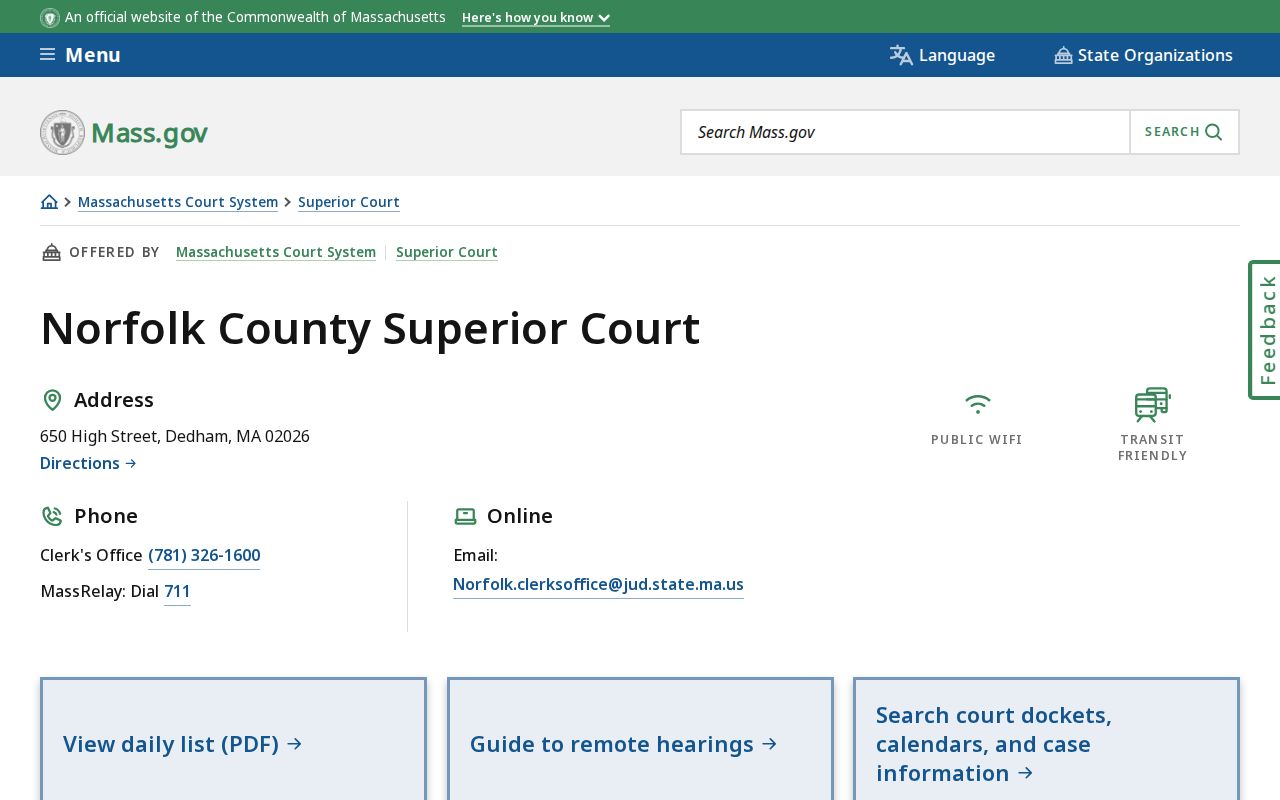
The address matters, because the clerk of courts works from that Dedham building.
Norfolk County Superior Court, Clerk's Office
650 High Street
Dedham, MA 02026
(781) 326-1600
Norfolk County Sheriff, Civil Process Division
1255 Hancock Street
Quincy, MA 02169
(781) 326-7271
Criminal process may be served anywhere in Massachusetts by law. So a Norfolk County warrant can be executed in another county. The officer need not carry the paper at arrest, but must show it or explain the charge promptly.
Norfolk County Default and Payment-Only Warrants
Some defaults are only about money. When a warrant exists because a fine, court cost, restitution, or support payment went unpaid, the warrant should state the amount owed plus a $50 assessment. Norfolk County courts may accept payment by mail, telephone, or an approved electronic method.
- Ask the clerk whether the Norfolk County warrant is payment-only or whether it also requires a court appearance.
- Confirm the exact amount, including any assessment, and ask whether part of it can be waived for hardship.
- Use only a payment method the court approves. The clerk decides whether an ePay payment discharges your default.
- Keep the receipt, and ask when the discharge will be entered in the Warrant Management System.
The recall fee is separate from what you owe. In Norfolk County the fee to recall a default warrant is $50, and a court can waive it for hardship. A $75 arrest fee can apply after a bail or recognizance default.
If You Have a Warrant in Norfolk County
Start with the Clerk-Magistrate at the issuing court. The jail can't fix it, and neither can a caller claiming you owe money. Give the clerk your name, your docket number if you have it, and the date you missed. Then ask how the Norfolk County court wants you to proceed.
Important: Speak with a defense attorney before turning yourself in, and do not discuss the facts of the case with police or court staff.
Go early if you walk in. Staff pull the file, probation may gather its information, and a judge then decides whether to recall the Norfolk County warrant. Carry photo ID, any court notice, proof of a medical or notice problem, and a way to pay. Request written proof of the recall before you leave.
Norfolk County Treatment and Specialty Court Dockets
Two Norfolk County courts run specialty sessions that change the calendar. Quincy District Court lists an Adult Drug Court and a Mental Health Court, while Dedham District Court houses a Veterans' Treatment Court. A warrant question out of those sessions may go straight to a probation officer. Child support runs on a separate track. That belongs to Probate and Family Court, and Norfolk Probate and Family Court sits at 35 Shawmut Road in Canton. For a Norfolk County warrant tied to unpaid support, call that court or the issuing one.
Norfolk County Warrant Records and Public Access
Massachusetts runs two access systems side by side. The Public Records Law governs records a government office makes or receives. Court records follow the Uniform Rules on Public Access to Court Records instead. A Norfolk County docket may be viewable at the courthouse yet unavailable remotely.
Key Rules:
M.G.L. c. 66, § 10 - the right to request records from a state or local office in writing.
M.G.L. c. 4, § 7(26) - the exemptions that let an office withhold or redact a record.
M.G.L. c. 276, § 2B - a search warrant affidavit stays nonpublic until the warrant is returned.
M.G.L. c. 6, § 172 - CORI follows its own rules and is not a warrant search.
Juvenile records face the tightest limits. Never republish a juvenile's name or warrant information. Sealed records and open investigations can also keep a Norfolk County record from ordinary public view.
Warrant Payment Scams in Norfolk County
Watch for phone scams. In the fall of 2025, the Sheriff's Office warned that callers posing as deputies and local police claimed residents faced arrest over missed jury duty or an outstanding warrant. One resident paid at a Bitcoin kiosk after a fake court document arrived. Another lost more than $31,000. No Norfolk County court or police department collects money that way.
- Hang up, and do not confirm your name, address, or date of birth to an unsolicited caller.
- Never pay with cryptocurrency, gift cards, prepaid cards, or a wire transfer.
- Find the court's own number on an official page and call to ask whether anything is pending.
- Report the call to your local police department.
Note: A real notice about a Norfolk County default warrant comes in writing from the issuing court, never by phone demand.
Norfolk County Juvenile and Sealed Warrants
Juvenile Court keeps its own locations, clerks, and privacy rules. Dedham Juvenile Court serves the county's western and northern municipalities. Quincy Juvenile Court covers Braintree, Cohasset, Holbrook, Milton, Quincy, Randolph, and Weymouth. Stoughton Juvenile Court hears scheduled sessions. Daily lists show only a case number, an event, and a session. Sealed records and open investigations can hide a matter, so a missing Norfolk County record is not a clearance.
Norfolk County Warrants by City
Police departments arrest and hold reports. The District Court serving each municipality controls the warrant. Norfolk County's five largest municipalities are Quincy, Brookline, Weymouth, Braintree, and Randolph.
Quincy Warrant Search
101,636 · Quincy Police and Quincy District Court
Brookline Warrant Search
63,191 · Brookline Police and Brookline District Court
Weymouth Warrant Search
57,437 · Weymouth Police and Quincy District Court
Braintree Warrant Search
39,143 · Braintree Police and Quincy District Court
Randolph Warrant Search
34,984 · Randolph Police and Quincy District Court